
The story of Primitive Methodism in Bishop Auckland has been told on another page , but few details have been given of the second chapel, Tenters Street, which opened in 1868 and continued in use until 1937.
Matthew Richley gives a full account of the building and opening of Tenters Street:
“On the 10th of April (Good Friday) of that year[1868] the foundation stone of the present structure was laid by Charles Pease, Esq. , of Darlington, in the presence of a large assembly of ministers, laymen, and the general public.
The proceedings commenced at two o’clock by the meeting engaging in devotional exercises. A bottle containing a paper on which was inscribed the names of the trustees of the new building ;the names of the architect, mason, joiner, slater, painter, and inspector ; also the number of members in the society in connection with the Primitive Methodists in Bishop Auckland ; the number of scholars and teachers in the Sabbath-school ; a copy of the ” Auckland Times and Herald,” the ” Auckland Chronicle,” the ” Durham Chronicle,” Connexional publications, the name of Charles Pease, Esq. , and a circuit plan containing the names of the circuit ministers, was then placed in a cavity of the stone by Mr. Watson, the builder. The Rev. L. F. Armitage then presented a copy of the ” History of Primitive Methodism” to Charles Pease, ” Esq. , who, after making a few suitable remarks, performed the ceremony in due form. A hymn having been sung, and prayer offered by the Rev. T. Boyd, the proceedings were brought to a close..
In the afternoon a tea party was held in the Town Hall, and in the evening a public meeting was held in the same place. Mr. F. Spoor occupied the chair, and addresses were delivered by the Rev. L. F. Armitage and other ministers. On the Saturday evening following, the Rev. J. A. Bastow, of Darlington (author of the ” Biblical Dictionary “) , delivered a lecture in the Town Hall, on ” The good old English Bible,” the chair being occupied by J. Proud, Esq.
The opening services were held on Sunday, the 5th February, 1869 , and were commenced with a public prayer meeting. Sermons were preached in the morning and evening by the Rev. J. T. Harwood, Wesleyan minister, of Crook. The Rev. T. Boyd, Presbyterian minister, of Bishop Auckland, delivered an appropriate discourse in the afternoon.
On the following day a tea meeting was held in the School-room underneath the chapel, when about 400 persons were present. A sale of fancy needlework and other articles was also opened the same afternoon. After tea a public meeting was held in the chapel, at which Charles Pease, Esq. , presided, when suitable addresses were delivered by several ministers of the town.
The chapel , which cost about £1,000, is built somewhat in the Grecian style of architecture, from designs furnished by Mr. John Braithwaite, of Bishop Auckland. The front is adorned with dressed stone pilasters surmounted with carved caps, and in the centre above the door is a threelight window. The length of the chapel is 65 feet and the width 34 feet, and seats are provided for 350 persons. The old-fashioned pulpit is dispensed with, and in its place there is the modern rostrum. Behind this there is an orchestra twelve feet in length. In front of the orchestra and rostrum there is an open metal fretwork. Underneath the rostrum is a vestry 18 feet by 12 feet, suitable also for a class-room. The school, which is underneath the chapel, is 26 feet by 30 feet, 12 feet in height, and well lighted. On the same floor with the school there is a small house suitable for the residence of a chapel keeper. The various parts of the work were entrusted to the following :-Joiner’s work, Mr. John Braithwaite ; masonry, Mr. John Watson ; slating, Mr. Mascall ; painting, Mr. Pickering ; iron work, Mr. Wilson, of Blue Row Forge.”
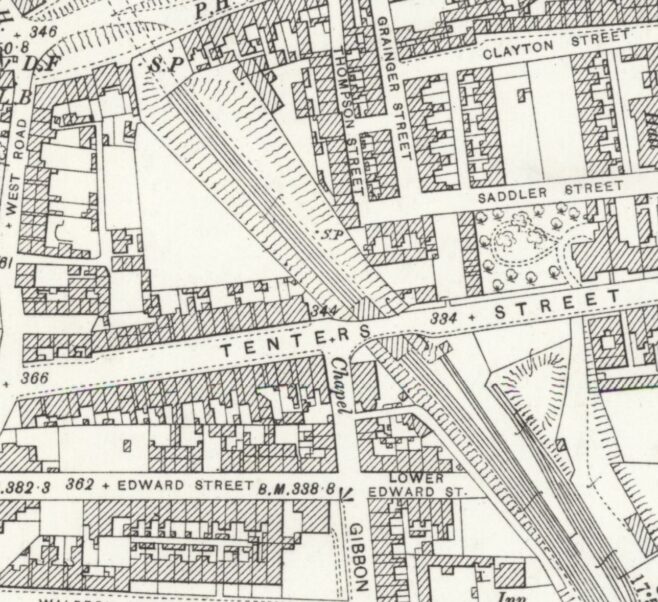
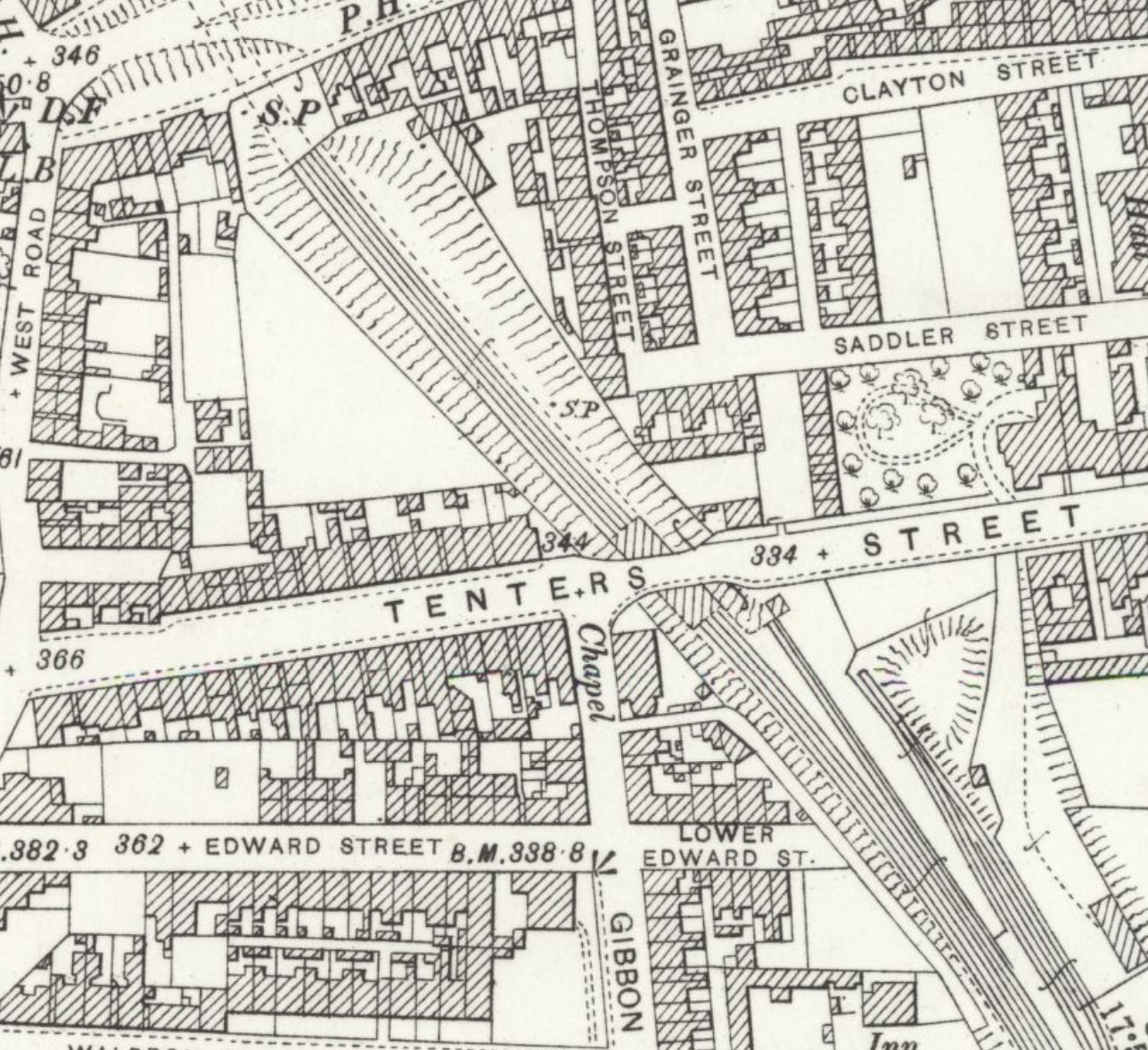
As yet no illustration of this building has been found, but as can be seen from the Ordnance Survey map of 1897, it was next to the railway. Although closed in 1937, the site has found a new Christian use since 1988 as Gibbon Street Christian Community Centre.
Source:
Richley, Matthew ‘History and characteristics of Bishop Auckland.’ Bishop Auckland: W.J. Cummins, 1872 pp150-151
No Comments
Add a comment about this page